La Puerta, La Mesa y El Grupo Local
Juan Pablo Garza

Andrew Rafacz
1749 W Chicago Ave, Chicago, IL 60622
Tue-Fri 10am-5pm, Sat 11am-5pm
Admission
Free Admission
About
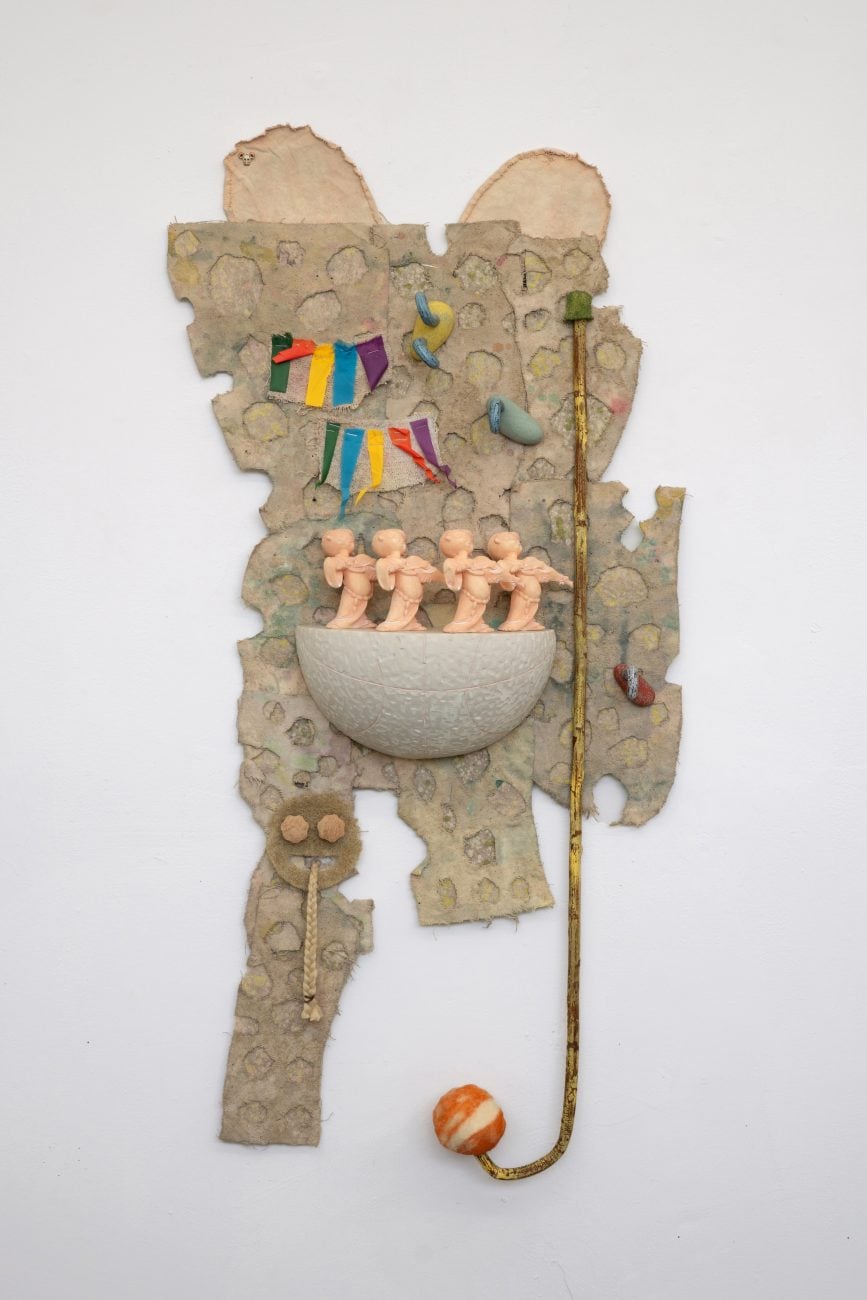
ANDREW RAFACZ is excited to announce _La Puerta, La Mesa y El Grupo Local_, an exhibition of new mixed media works from Juan Pablo Garza, in Gallery One. The exhibition opens Thursday, November 6th and continues through Saturday, December 19th, 2026. Utilizing a diverse range of materials and employing a multidisciplinary approach, Venezuelan-born and Miami-based artist Juan Pablo Garza describes his practice as a 'speculative exploration of objects.' Weaving together visual conversations that bridge the ordinary and the unfamiliar, Garza engages in a purposeful search for charged objects and materials—whether found, acquired, or built—and selected for their cultural resonance, aesthetic allure, rareness, or awkwardness. He then transforms them through deliberate manipulation and intervention, fitting them seamlessly into his constructed universe, a space that is defined by both instinct and logic. Elemental objects merge into unique formal structures, with the results ending up both floor-standing and installed on the wall. The dynamic interaction between objects and materials is at the core of Garza's practice, a process that blurs temporal boundaries and reshapes expected meanings. Laden with emotional and historical weight, each object becomes a vessel for his densely constructed narratives. Through this act of building, Garza navigates the complexities of his own identity, while addressing themes of fragility, resilience, memory, and loss. His constructions refine a poetic language that formalizes the accidental, reinterprets history, and celebrates the complexity of ambiguity. In his first exhibition with the gallery, Garza confronts the traumas, sorrows, and joys of his own childhood, while seeking to bring together the everyday, the geographical, and the cosmic. The exhibition's title, _La Puerta, La Mesa y El Grupo Local_ (The Door, the Table, and the Local Group), references places that are very important to him. La Puerta and La Mesa are two small towns in the Venezuelan Andes that hold an important place in his upbringing, suggesting an almost exaggerated romanticization of the bucolic and the pastoral. They also refer literally to familiar objects that hold formal and conceptual significance for Garza: la puerta (the door) and la mesa (the table). El Grupo Local (The Local Group) meanwhile, refers to the group of galaxies to which the Milky Way belongs. Garza explains: 'I'm interested in moving between a specific place tied to my own history and a cosmic scale that is difficult to grasp and inevitably strikes us as mysterious: the local, the immediate, and the unfathomable; what feels close and what seems beyond reach—all of it shaped by forces we do not fully understand. I think about the mysteries of the universe in relation to our belief that we know ourselves and are in control of our actions. We tend to deny how deeply the 'self' is bound up with chemical and biological factors. If those conditions had been different, we would have been different too. What we believe ourselves to be is, in that sense, just one possible manifestation among infinitely many. Understanding ourselves and knowing what drives us takes enormous effort. Even what is most familiar to us and seems to define us—childhood, home, memories—can be as strange, unfathomable, and mysterious as our dear Local Group.' For Garza, the 'table' functions as a surface on which to arrange objects, with a direct nod to still life. The 'door' reflects his need to open up possibilities within the work: to see how far he can go, to avoid the formulaic, and to keep resisting repetition. He notes, 'what interests me, in any case, is creating a kind of world in which the works, in their various manifestations, keep one another company. Some behave like animals or landscapes; others take on the texture and shape of food. The one over there seems to have a practical function, and so on. The work is rooted in memories, objects, and stories, but it does not try to imitate our known world. It builds a world of its own and finds its reason for being within it.'