What Remains in Place
Pegah Keshmirshekan

Gallery Under The Mango Tree
Merseburger Str. 14, Berlin, Berlin 10823
Wed-Fri 15:30 – 18:30, Sat/Sun 13:00 – 16:30
Admission
Free Admission
About
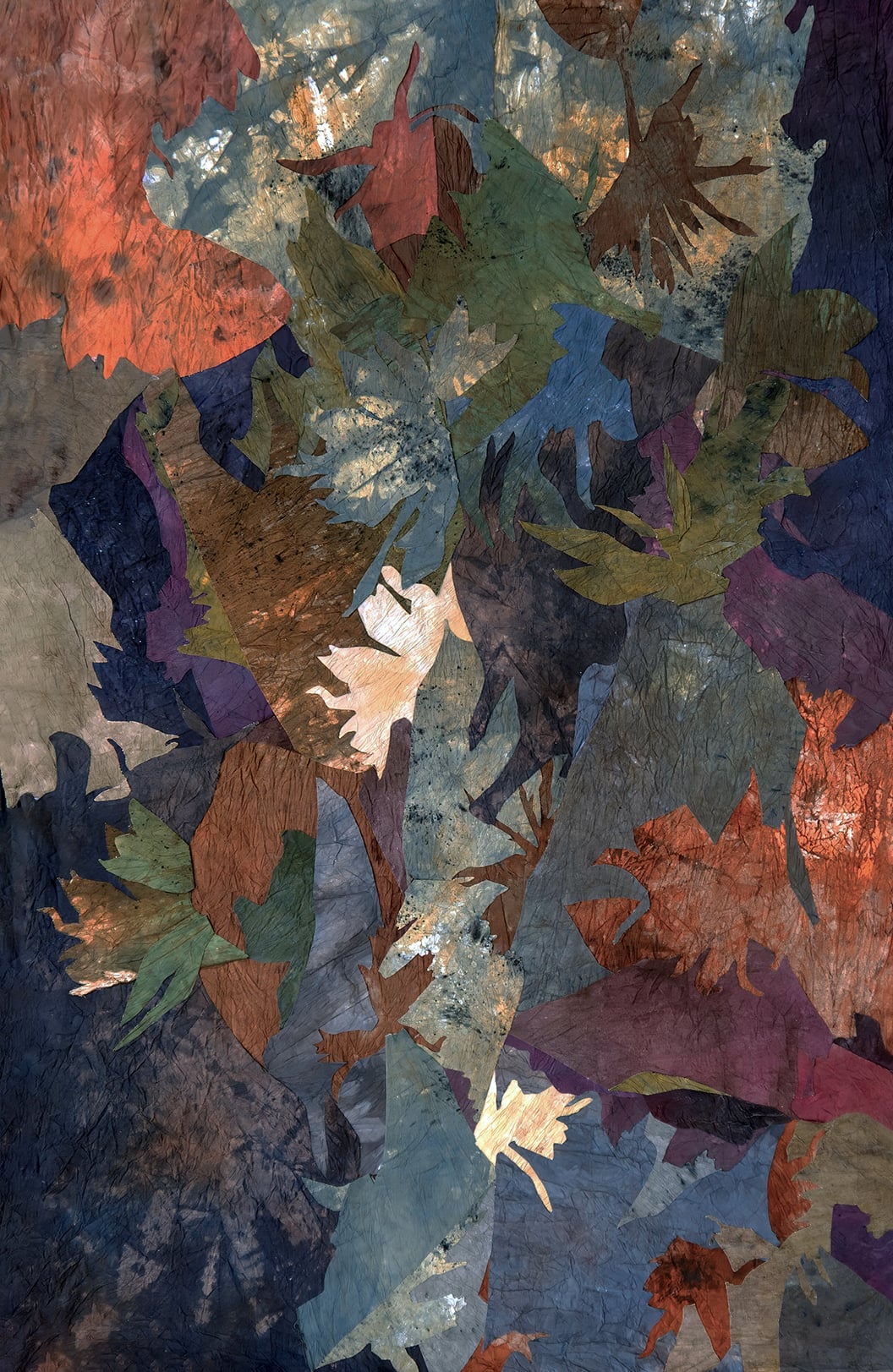
Gallery Under The Mango Tree is proud to present What Remains in Place, the second solo exhibition of Tehran born, London and Berlin living artist Pegah Keshmirshekan (\*1996). Building on the themes of her first exhibition Imaginary Homeland, Keshmirshekan continues her engagement with displacement, memory, diasporic identity and issues related to ecology in a new body of textile-based works. While her earlier works consisted primarily of paintings functioning as contemporary interpretations of 17th-century Dutch still lifes, engaging with cultural remnants from “elsewhere” and the circulation of floral imagery within Western pictorial traditions, What Remains in Place marks a significant shift within her practice. In turning towards textile, fragmentation and processuality, Keshmirshekan moves away for the first time from the visual language of the exoticised floral image itself. A central theme of the exhibition is the crown imperial (Fritillaria imperialis), known in Persian as Laleh-ye Vajgun(„weeping tulip"), a flower native to the Zagros Mountains, a region spanning Iran, Iraq and Turkey. Deeply rooted in Persian mythology and folklore, the flower becomes a symbol of an imagined homeland in Keshmirshekan‘s works – one defined less by geographical borders than by memory, sensation and inherited stories. The exhibition unfolds through dyed textiles, fragmented floral constellations and layered surfaces created through an experimental process of fabric dye, salt, hot water, cutting, sewing and reconstruction. Guided by unpredictability, the works allow for instability and transformation, permitting colour, texture and form to develop organically across the surface. By keeping both the positive and negative pieces of cut fabric, Keshmirshekan builds images from what remains and what has been removed. Drawing from herbarium archives and images connected to the illegal picking of the flowers in Iran, Keshmirshekan reflects on the tension between preservation and displacement. The crown imperial moves between myth and archive, East and West, rootedness and circulation, survival and extinction. Although the flower was historically brought to Europe and classified within Western botanical systems, it is today increasingly threatened in its natural habitat by climate change and ecological shifts. As suggested in the accompanying essay Home as a Dense Geography of the Self, by cultural practitioner Övül Ö. Durmuşoğlu, the exhibition resonates with Gloria Anzaldúa‘s notion of a „geography of the self,“ in which identity is understood as layered, fragmented and in perpetual flux. Through visible seams, repaired surfaces and recurring floral forms, What Remains in Place examines what endures after migration, rupture and distance – and how belonging can persist through emotional and sensory memory. With this new body of work, Keshmirshekan expands her multidisciplinary practice into a poetic reflection on fragility, repair and the dense landscapes of the self. Pegah Keshmirshekan is an award-winning artist whose works are included in several international private collections. She was awarded the Elsa Neumann Scholarship (Berlin) in 2025 and the Schulz-Stübner Prize in 2023. Her work has been exhibited internationally, including at Asia NOW Art Fair (Paris), SAVVY Contemporary (Berlin), and the Academy of Fine Arts Vienna, as well as in exhibitions across London, Tehran, and Stuttgart. **Artist statement** “The work begins to function as unstable herbaria of an imagined homeland. A herbarium is a practice of preserving plants by pressing and classifying them, removing them from their natural environment in order to stabilise and archive them. It promises preservation, the possibility of holding what is fragile in place. Yet extinction and diaspora complicate this promise. The textile works become a record of a plant that cannot be fully held in place, whether geographically, ecologically or emotionally.” – Pegah Keshmirshekan, 2026 Essay: Home as a Dense Geography of the Self, Övül Ö. Durmuşoğlu, 2026 “If not in images, smells and feelings imprinted in one’s heart, where is home? What is the measure of distance that connects one to their home?” Pegah Keshmirshekan, born in Tehran and now living in Berlin and London, has followed these root questions in her long-term artistic research into Iran’s native Crown Imperial flower (scientific name Fritillaria imperialis), exploring its use as a symbol of an imaginary homeland. This bell-shaped wildflower, known as Laleh-ye Vajgun (upside-down tulip) or Laleh-ye Ashk (weeping lily), was brought to Europe in the mid-sixteenth century and was depicted in countless paintings and on ceramic tiles by 1610. In Iranian folklore and in the epic poem Shahnameh by Ferdowsi, the flower is deeply intertwined with Nowruz, the Persian New Year celebration marking the arrival of spring and the renewal of nature, as well as pre-Islamic mythology. Legend has it that it sprouted from the spilled blood of Siavush, a heroic Persian prince. Its homeland, the Zagros Mountains, is a historically unyielding range that is home to many nomadic families. It begins in northwestern Iran, roughly following the western border, and covers much of southeastern Turkey and northeastern Iraq. The mountains also create a geographic barrier between the Mesopotamian Plain, in modern-day Iraq, and the Iranian plateau. The Crown Imperial of Zagros is considered a threatened species due to climate change, overgrazing, agricultural changes and unmanaged tourism. What is an identity that isn’t a performance, an act of projection, an artifice or a fiction? Humans carry billions of bits of information within them; communities of selves are inscribed on their bodies. They have not one home, but many interconnected ones. The most fundamental question is that of belonging. Laleh-ye Ashk grows on the border between different geographical and historical plains, such as Mesopotamia and Persia, the pre-Islamic and the Islamic eras, the imperial and the colloquial, tradition and progress, nativity and cultivation, and roots and circulation. This plant projects a double consciousness, implying a significant alteration in meaning between insisting on a fixed identity, which is a fiction, and consciously claiming stories that complete the puzzle of identity. Employing this double consciousness, Keshmirshekan began her new series by investigating the herbarium data of the flower, which already carries the stigma of Western botanical naming, classification and categorisation systems in its species name. These collections of plant samples are preserved for long-term study and are usually in the form of dried and pressed plants mounted on paper. They help scientists with plant identification and research and provide historical records of Earth’s biodiversity and conservation. However, as many historians know, the best-kept secret about any archive is what you don’t find. The lived histories, feelings, confusions and projections of these communities of selves can’t be categorised or archived. The loss of a homeland, a sense of being ungrounded or a search for roots cannot be archived either. Keshmirshekan created her templates using images of flowers picked from the Zagros mountains alongside herbarium images. She keeps returning to the contradiction between the archived flower and the endangered flower in its natural habitat. Archiving a flower won’t save it from the dangers of extinction. On the other hand, the depiction and abstraction of flowers has a long-standing history in Islamic visual culture, from the Mughals and Persians to the Ottomans. The Sufi belief that the love and power of the Creator is mirrored in every created being adds an earthly meaning and a celestial twist to what the uneducated eye would see as mere floral ornamentation, setting it apart from the exquisite and precise Western still-life tradition. Dutch impossible bouquet paintings starring Crown Imperial are a good example of how the Western still-life tradition is based on the tension between categorisation and fantasy, both of which are located in the gaze. In her textile imprints, Keshmirshekan experiments with the form and depiction of flowers, searching for that diffusive territory of identity that can only be grasped upon stepping foot on it. This is a place that cannot be limited to the Crown Imperial (Fritillaria imperialis) and the Laleh-ye Ashk, but which can encompass them both. This territory closely resonates with the understanding of the geography of selves and the bridge metaphor of Mexican feminist thinker Gloria Anzaldua: ‚Caminante, no hay puentes, se hacen puentes al andar‘ (‚Traveler, there are no bridges, you make them as you walk‘). Each textile surface, dyed by the artist, becomes a tender surface, embedded with things that cannot be fully held in place, whether geographically, ecologically or emotionally. These surfaces bridge viewers to places they may not have encountered before. Each new landscape created with patterns cut from these treated textiles moves beyond mental fantasy to a heartfelt negotiation of the unpredictable future displacement of the flowers in the Zagros region. The process behind each piece of work also points towards that search, discovery and acknowledgement. Starting with a canvas dyed with fabric dye, salt and hot water, Keshmirshekan discovered that the colour settled unpredictably across the fabric, creating different stains, patterns and tonal shifts. Allowing herself to be guided by this unpredictability, the artist expanded her sense of self within the geography of her identity. Each constellation of flowers refers to the communities of selves that we carry within us as humans: broken selves looking for the missing piece of the puzzle. Salt, an element of the earth, has cleansing and preserving properties. It fixes the dye and remains visible in granular form on the surface. As in the search for meaning, there is tension between what remains and what transforms before a new threshold is reached. The cut and reassembly of fabric fragments with visible threads and glue implies the violence and fragility of fragmentation and its potential for repair. Working from herbarium images showing the healthy and deteriorated states of plants speaks of a healing process that always leaves a trace. This life force breaks the human-made codes of representation and categorisation, implying that growth can take place in unexpected forms. Some shapes can be identified more clearly, while others appear in denser constellations, accompanied by colour variations. ‚No matter how much labour I put in here, I still can’t feel a sense of belonging,‘ I overheard in Turkish as I passed a café I often visit, particularly for its Levantine-inspired menu. The owner had made this confession on a Sunday afternoon in spring, which would lead to the celebration of Hidirellez, also known as Ederlezi, celebrated across Turkey, Crimea, Gagauzia, Syria, Iraq, the Caucasus and the Balkans, and is very similar to Newroz. According to legend, Persephone appears from underground at this time to meet her mother Demeter, and protectors of land and water are said to gather to grant wishes. So, is this person’s wish for Hidirellez an embodiment of that sense of belonging? Can one come to a city like Berlin and put down roots? Having long lived away from Anatolia, which I consider home, this simple yet complex question resonates deeply with me. “What Remains in Place” is the title of the second solo exhibition by Pegah Keshmirshekan in the _Gallery_ _Under the Mango Tree_. “Throughout this project, I was constantly brought back to it, not only as a question — what really does remain in place? — but also as a statement: this is what has remained,” the artist emphasises. This acknowledgement speaks volumes not only about displacement and extinction as codes for the future of the Earth, but also about the strength of the heart that carries the scents, sights and sensory imprints of what home and belonging may mean in this world right now. There are things we know, things we know we don’t know, and things we don’t know we don’t know. No matter what ideologies, knowledge systems and beliefs try to force upon us, this complexity cannot be reduced to polarised simplicity. The stories of many storytellers from around the world guide humans through the dense landscape of existence on this planet, helping them to cross the initially unbridgeable gaps. Perhaps that is why home can only be perceived by acknowledging and appreciating this density. Pegah Keshmirshekan’s flower constellations open a path towards that journey, showing the fragility and strength of plants that carry so much within them. Her journey of self-knowledge invites her audience to join her on this path.