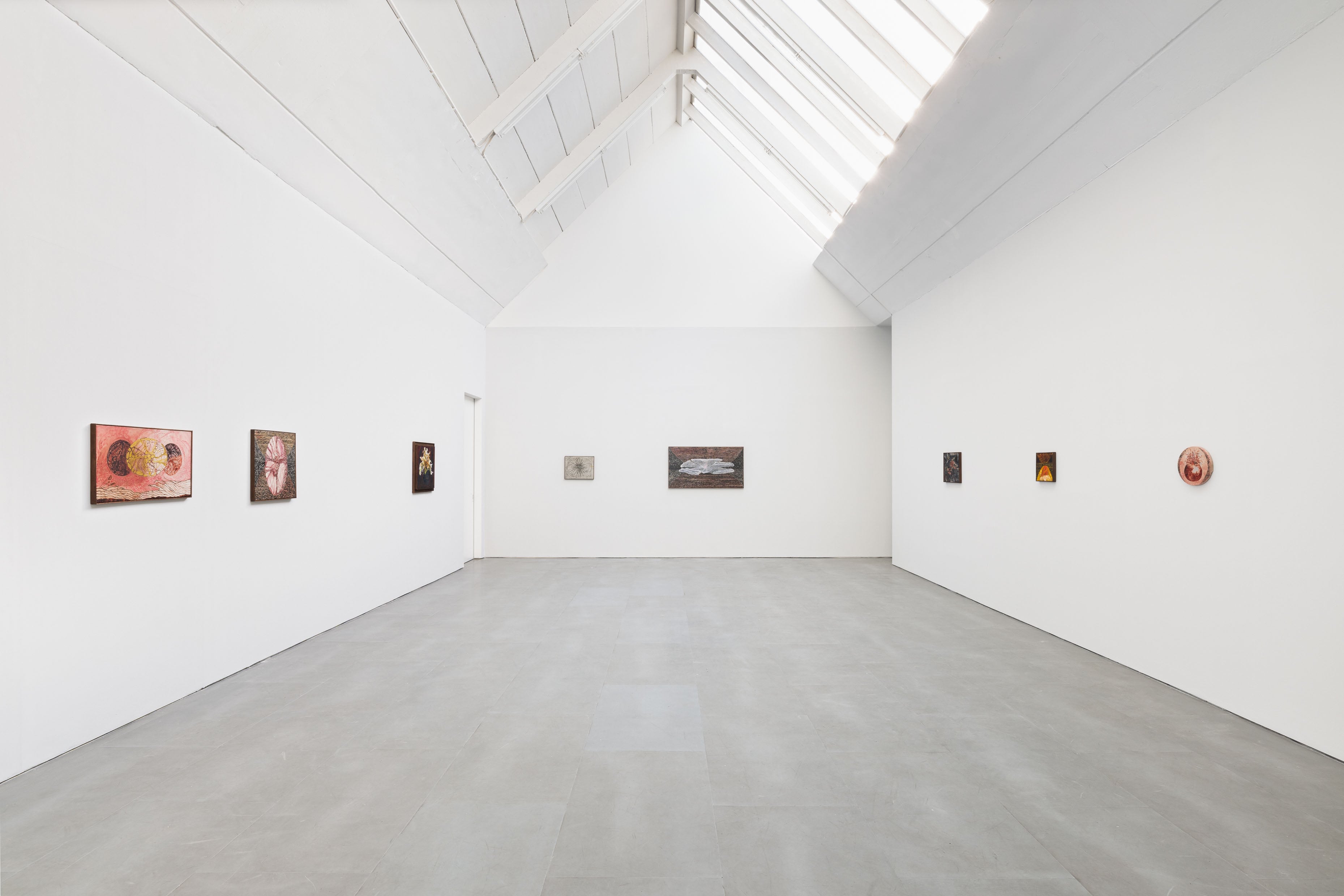
Drift
Stevie Dix

carlier | gebauer
Markgrafenstraße 67, Berlin, CA 10969
Tue–Sat 11am–6pm
Admission
Free Admission
About
For over a decade, Stevie Dix has perfected a muffled, moody painterly universe in perpetual expansion. Gradually, her practice introduced a set of key motifs: fragments of garments, elusive female profiles, paths that led nowhere. These hieratic symbols were rendered in a thick mix of oil and beeswax, establishing a subtle palette of earthy tones that made the outside world disappear as if perceived behind closed blinds—or eyelids. Her second exhibition with carlier | gebauer, and the first in the gallery’s Berlin space, sees the Belgian artist explore uncharted territory. Her new body of work was created in the aftermath of a personal ordeal, the artist having lost her mother as she prepared to welcome her son. _Drift_, the title of the show, evokes how grief, loss, and joy blend into one another in “a changing state, undesirable and unstable”. When Dix returned to the studio, the medium of painting became akin to a vessel or a loom. Her mother had been an artist herself, a gifted painter and potter who used to document her works in makeshift settings, photographing them with a disposable camera. These hazy, faded snapshots became the starting point for Dix’s new paintings, such as the pale-yellow canvas featured in the exhibition, which turns a staged photograph of a ceramic vase with dried flowers into a biomorphic, incandescent motif. Repeated throughout several works, it acquires the germinating quality of a cell, an atom, or a seed, in ceaseless transformation. As Dix dives deeper into a more abstract register, we are brought back to the spiritual origins of Western abstraction: a way of communicating with the unseen, channeling a repertoire of shapes evocative of rays of light and electromagnetic signals. From 1977 to 1979, Roland Barthes kept a _mourning diary (Journal de deuil)_ recording the subtle flow of sadness, the stages of grief, and the universality of loss. The French semiotician started writing the day after his mother’s death, using small slips of paper in what soon became a daily practice. He felt the need to shift his academic mode of writing toward fiction. As he wished for a new beginning, he named it _Vita Nova : new life_. For Dix, grief similarly became a catalyst for formal renewal as it led her latest paintings toward a primordial, pared-down form of expression. Throughout the space, the initial references give way to carmine symbols interconnected through pulsating undercurrents. Morphing into bristling tendrils and imploding globes, they take on a cosmic existence of their own.