Animal Mirror
Jelena Bulajić, Diego Delas, Cecilia Edefalk, Asta Gröting, Thibault Hiss, Aki Inomata, Julia Kowalska, Lin May Saeed, Pakui Hardware, Paolo Salvador, Sequoia Scavullo, Erik Schmidt, Thomas Schütte, David Zink Yi, Paloma Varga Weisz

carlier | gebauer
Markgrafenstraße 67, Berlin, CA 10969
Tue–Sat 11am–6pm
Admission
Free Admission
About
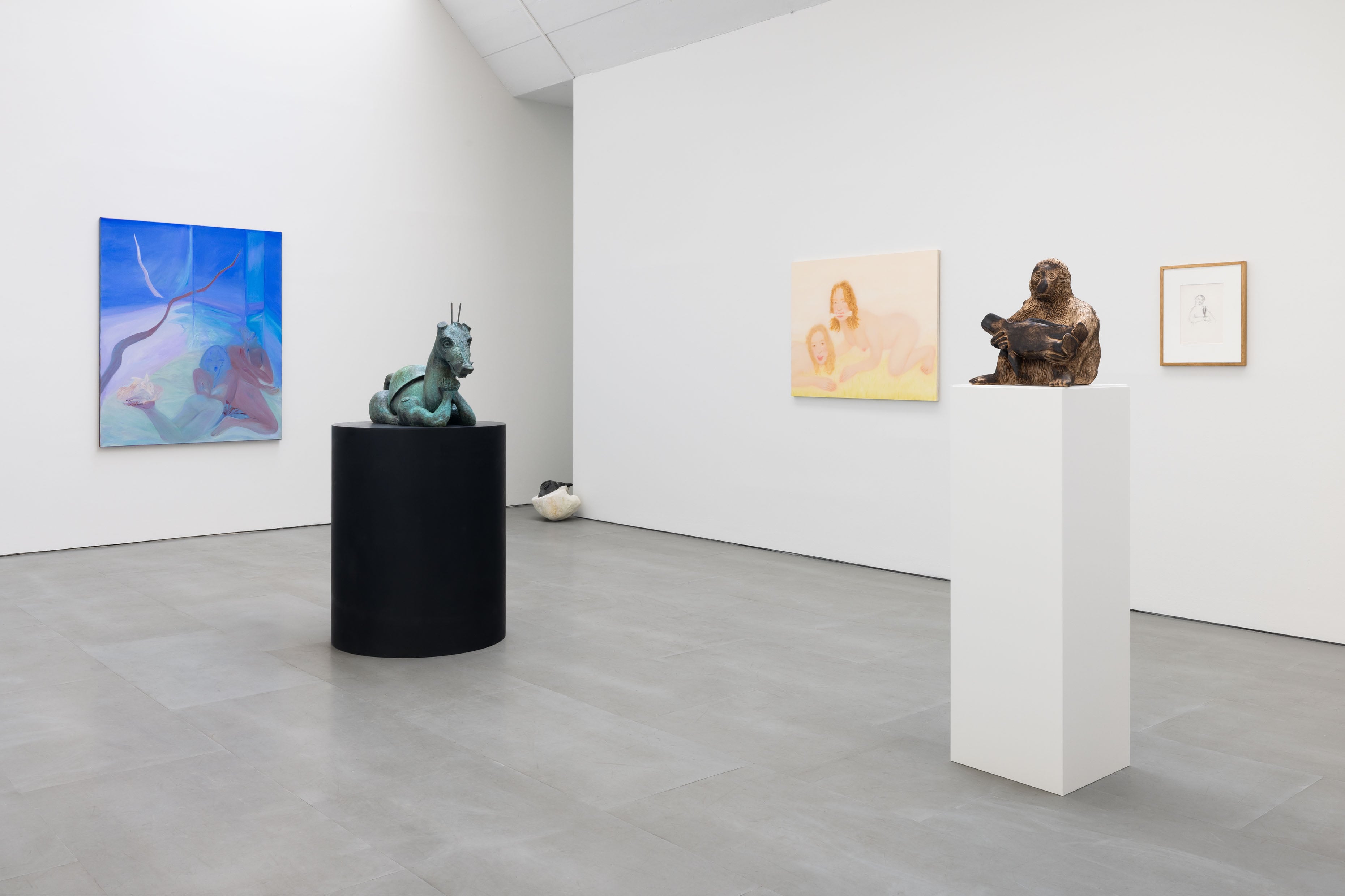
Few relationships are as old, as contradictory, and as unresolved as the one between humans and animals. We share our bed with them and our plate. We worship them and we slaughter them. We search their eyes for an answer they cannot give us, and precisely because of that, we project so much into them. In contemporary art, this field of tension is gaining significance because it allows something to be negotiated that reaches far beyond zoology: our self-understanding as a species, our ethics, our fears, our longings. The exhibition brings together fifteen artistic positions that approach this relationship from very different directions. Here, the animal appears as companion and confidant as much as source of food and sacrificial creature, two roles that in our culture often lie only a few steps apart, yet are rarely thought together. It appears as cuddly toy and as symbol, charged with meanings drawn from mythology, religion, and folklore, and at the same time as a trigger for immediate, barely controllable emotions: affection, disgust, compassion, and fear. At the same time, the exhibition considers the animal as part of a larger ecological and evolutionary fabric: as a fellow inhabitant of a shared planet, as a participant in a biological heritage to which we are more closely related than everyday understanding often allows. And finally, the most radical question arises: what if the animal is not merely subject matter but the author itself? What if animal behaviour, movement, and intelligence themselves become artistic material? Aki Inomata literally lets animals co-create, putting human authorship itself up for debate. Lin May Saeed has devoted her sculptural work for years to questions of empathy and liberation in our relationship to animals. Pakui Hardware address bodies, biotechnology, and the permeability between the organic and the artificial. They explicitly refer to prehistoric organisms whose DNA structures lend new meaning to the fountain of youth today. Asta Gröting and Thomas Schütte place the animal within a matrix of social reflection, while Paloma Varga Weisz draws and sculpts anthropomorphic and hybrid figures. Julia Kowalska depicts figures in ambiguous emotional states and reciprocal relationships, shaped by emotional dependency and contradictory forms of affection. She often begins from an introspective perspective: her paintings extract the physical from the subconscious, creating delicate, dreamlike visual worlds. Intimacy, corporeality, and an enigmatic, ephemeral perception are central to her work. Diego Delas and Paolo Salvador develop their own, often dreamlike and shifted pictorial worlds in painting, in which tactile and emotional experiences flow into one another. Thibault Hiss and David Zink Yi extend the field through material approaches that render the animal tangible as transformed matter or as a presence in space. Cecilia Edefalk works in her paintings with minimal yet meaningful shifts. Content, context, and emphasis raise questions about painting and representation, as well as about the "screen" through which we perceive reality. Erik Schmidt's work revolves around (queer) identity, social role models, consumption, and social structures. He immerses himself as an intense observer in the rituals and behavioural patterns of social groups. His work _Day Gray_ offers a view of a veiled urban landscape occupied by pigeons. At the very beginning of the exhibition, Jelena Bulajić uses photorealism to create the illusion of an idealised "wildlife." In doing so, she establishes the conceptual framework of the exhibition from the outset. Whatever direction our gaze toward the animal takes, it is accompanied by projections and emotions. These reflect the human being more than they describe the animal.